How to Choose Between Frappe, Django, and Laravel for Your Next Project
A founder messages their CTO at 11 p.m.: "We need to ship an MVP in six weeks. What are we building this on?" 🌙 Pick wrong and you're rewriting the permissions system in month four; pick right and a two-person team ships what a ten-person team would need a quarter for.
This isn't a popularity contest between Frappe Framework, Django, and Laravel — all three are mature, production-proven, and power real companies today. Below, we walk through the architecture, auto-generated tooling, permissions, background jobs, and hiring reality so you can make this call with your eyes open. ✅
~14 minutes
Founders scoping an MVP 🚀, CTOs choosing a stack for the next 3-5 years, backend developers evaluating a framework switch, and technical consultants advising clients on build decisions.
Strip away the marketing and the choice comes down to one axis: how much do you want the framework to decide for you.
🧩 Frappe decides the most. Define a DocType (a schema-plus-behavior definition) and you instantly get a database table, an admin UI, a REST API, and permission hooks — no separate admin package, no separate API layer to wire up.
⚙️ Django decides a moderate amount. You get an ORM, an admin panel, and a request/response cycle out of the box, but the REST API, background jobs, and real-time layers are separate installs you configure yourself.
🎨 Laravel decides the least, by design. It gives you elegant, ergonomic primitives — Eloquent, Artisan, queues — but the admin UI, API scaffolding, and dashboards are typically third-party packages (Nova, Filament) you choose and pay for or install separately.
None of this makes one "better." ⚖️ It makes them suited to different problems, which is what the rest of this post digs into.
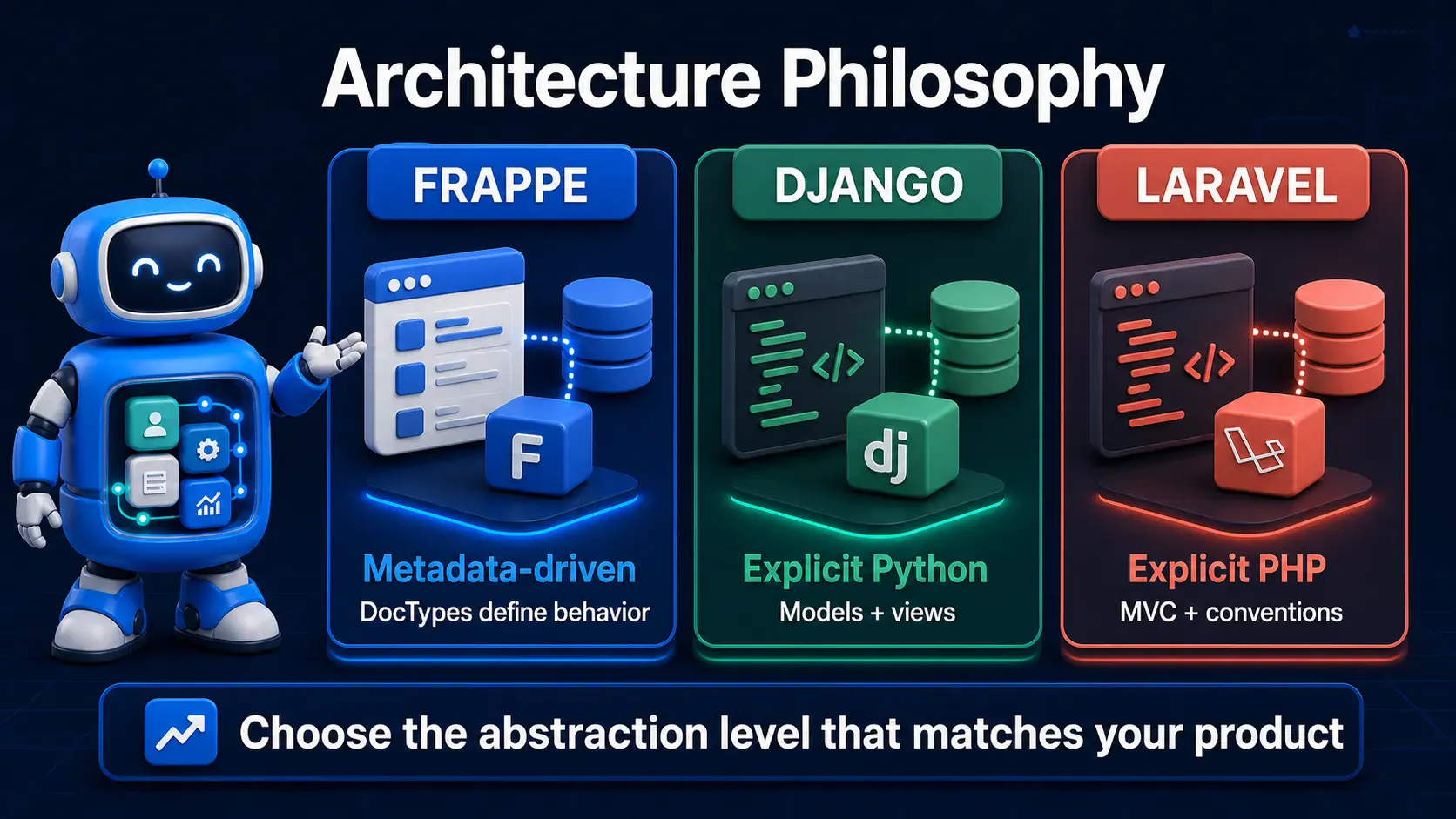
Frappe is metadata-driven. Instead of writing a Python class for every model, you define a DocType — essentially JSON metadata describing fields, permissions, and behavior — and Frappe generates the database table, forms, list views, and API endpoints from it. Business logic lives in Python controller hooks tied to that metadata.
Django is explicit Python MVC (technically MTV — Model, Template, View). Every model is a plain Python class you write by hand, every URL route is declared explicitly, and every view function or class controls its own logic. Nothing is generated for you beyond the admin panel — you write the code, and that code is the single source of truth.
Laravel is PHP MVC with an emphasis on developer ergonomics. ✨ Routes, controllers, and Eloquent models are all hand-written, but Laravel's conventions (naming, folder structure, the artisan CLI) make the boilerplate fast to produce and pleasant to read.
💡 Pro Tip: If your product's data model changes weekly during early discovery, metadata-driven Frappe lets you redefine a DocType in a UI form in minutes. If your data model is settled and complex business logic dominates, explicit code in Django or Laravel is easier to reason about and test.
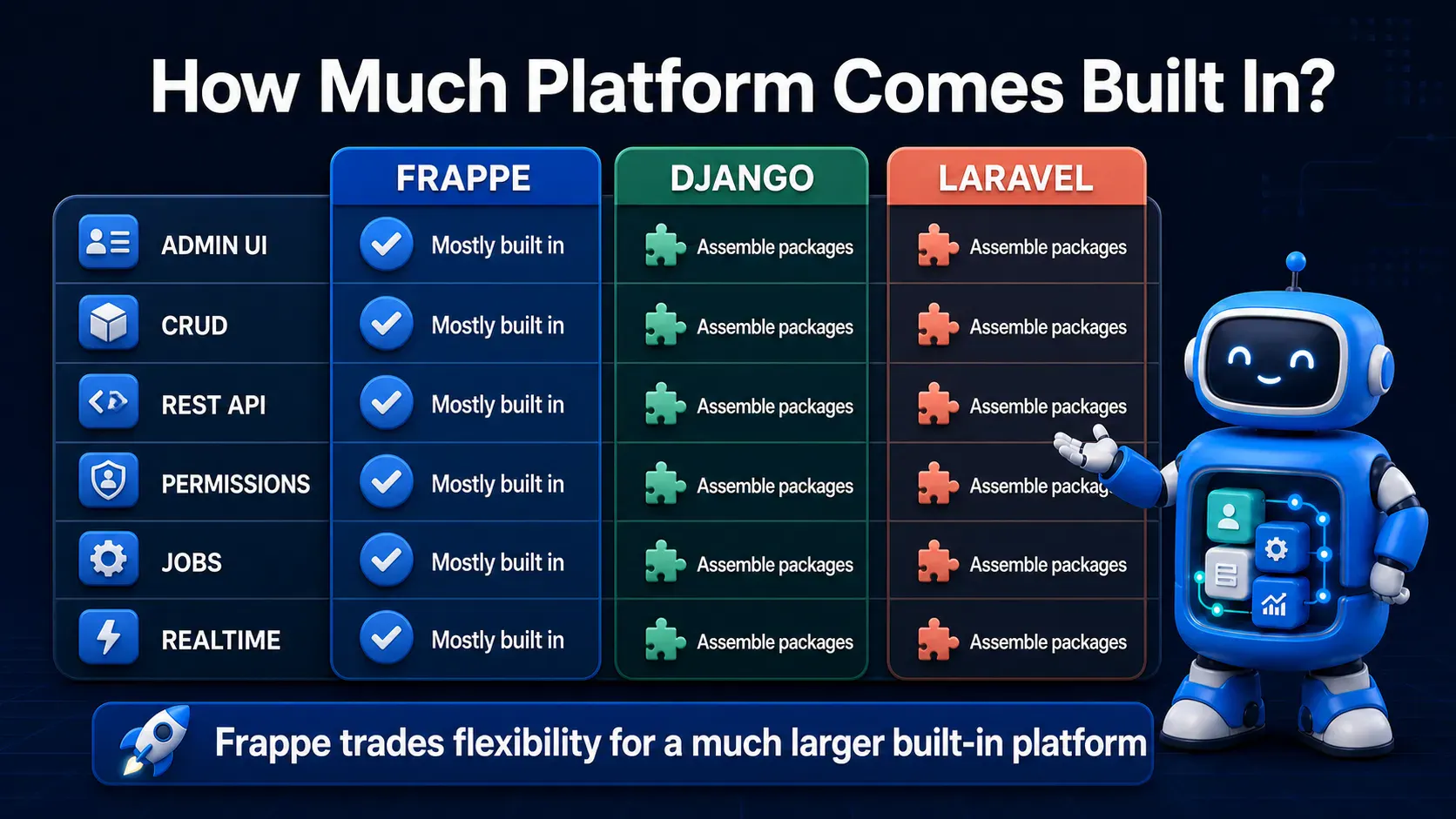
This is where the three frameworks diverge the most visibly.
🖥️ Frappe's Desk is a full admin application — list views, form views, filters, reports, and a kanban/calendar layer — generated automatically the moment you create a DocType. There is no separate "admin package" to install; it's the framework's default UI layer.
🛠️ Django Admin is also automatic and has shipped with Django since its earliest releases, but it's intentionally simpler: a CRUD interface over your models, styled for internal ops use rather than end-user-facing dashboards. Customizing it heavily (kanban boards, complex filters) takes real work.
🚫 Laravel ships with no admin UI at all. The ecosystem answer is Laravel Nova (paid, official) or Filament (free, community-maintained) — both excellent, but both are separate packages you install, configure, and keep updated independently of the framework.
⚠️ Reality Check: Frappe's Desk looks the most "done" out of the box, but it also means your admin UI is visually tied to Frappe's design system unless you invest in a custom frontend. Django Admin and Filament are easier to skin to match your brand.
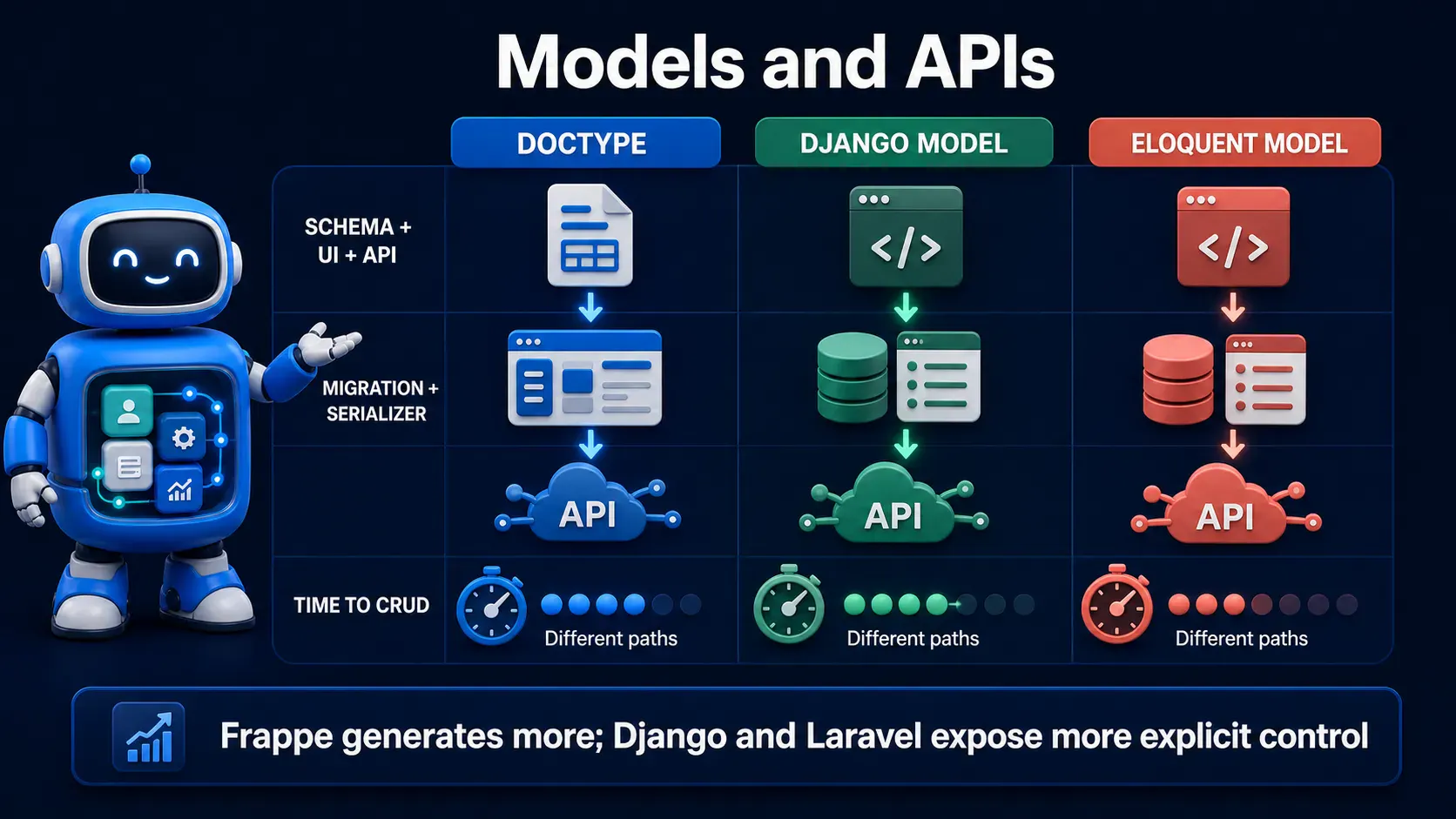
Building a data model in each framework feels genuinely different day-to-day.
In Frappe, a DocType is defined largely through JSON metadata (often edited via the UI, then exported to code), and Frappe auto-generates the underlying table and migration when the app is reloaded — you rarely hand-write a migration file.
{
  "doctype": "DocType",
  "name": "Support Ticket",
  "fields": [
    { "fieldname": "subject", "fieldtype": "Data", "reqd": 1 },
    { "fieldname": "status", "fieldtype": "Select", "options": "Open\nClosed" }
  ]
}
In Django, you write a Python model class, then run makemigrations and migrate to generate and apply an explicit migration file — a deliberate, version-controlled step.
class SupportTicket(models.Model):
    subject = models.CharField(max_length=255)
    status = models.CharField(choices=[("open", "Open"), ("closed", "Closed")])
In Laravel, you define an Eloquent model and a separate migration class using the schema builder, then run php artisan migrate.
Schema::create('support_tickets', function (Blueprint $table) {
    $table->string('subject');
    $table->enum('status', ['open', 'closed']);
});
✅ Django and Laravel's explicit migrations are easier to code-review and roll back precisely. ⚡ Frappe's generated approach is faster to iterate on but leaves less paper trail for exactly what changed and why between deploys.
If your product needs an API on day one, this section matters more than any other.
⚡ Frappe auto-exposes every DocType as a REST resource at /api/resource/<doctype> the instant it's created — full CRUD, filtering, and pagination with zero additional code, respecting the same permission rules as the UI.
GET /api/resource/Support Ticket?filters=[["status","=","Open"]]
🧱 Django requires Django REST Framework (DRF), a separate (if near-universal) package, where you define serializers and viewsets per model before you get a working API — more setup, but far more control over shape, versioning, and nested representations.
🔧 Laravel requires you to build API Resources and routes manually, or lean on Laravel Sanctum/Passport for auth plus hand-written resource controllers — again, more initial code, more long-term flexibility.
⚠️ Reality Check: Frappe's instant API is a genuine time-saver for internal tools and admin-facing apps, but public-facing APIs with strict versioning and response-shape contracts often still need custom whitelisted methods layered on top — it's a head start, not a finished product API.
Access control is one area where the frameworks' philosophies show up sharply.
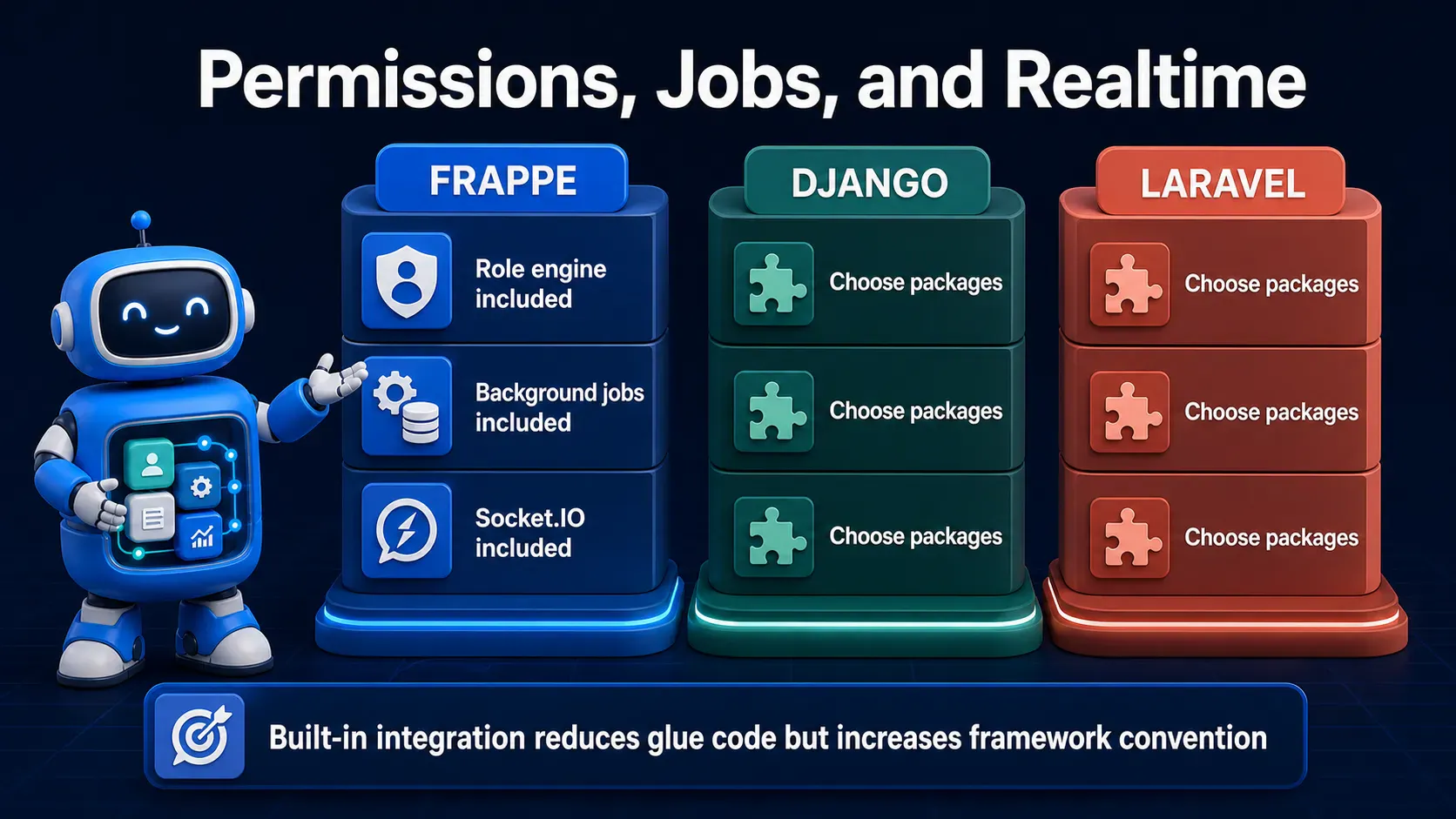
🔐 Frappe's permission engine is declarative and row-level by default — roles, permission levels per field, and "user permissions" that restrict records by owner or linked document, all configured without custom code, and enforced automatically in both the UI and the API.
📋 Django ships only a basic permissions framework (per-model add/change/delete/view flags tied to groups); anything resembling row-level or field-level permissions needs a third-party package like django-guardian or custom middleware.
🛡️ Laravel provides Gates and Policies — clean, explicit, code-defined authorization logic per model — which is powerful and testable, but again something you write rather than configure.
💡 Pro Tip: If your app needs "Sales reps can only see their own records" logic across dozens of models, Frappe's built-in row-level permissions will save you weeks compared to hand-rolling the equivalent in Django or Laravel.
Modern SaaS products need async work and live updates, and here's how each framework handles it natively.
📦 Frappe bundles a Redis-backed job queue and Socket.IO server as part of the framework itself — calling a background job or emitting a real-time event to the frontend is a single function call, no separate service to stand up.
🔄 Django needs Celery (with Redis or RabbitMQ as a broker) for background jobs, and Django Channels for WebSockets/real-time — both are well-documented, battle-tested, and near-standard in the ecosystem, but they're separate projects you integrate and maintain.
📊 Laravel's Horizon gives you a polished dashboard over its queue system (Redis-backed), and Laravel Echo (paired with a broadcasting driver like Pusher or Soketi) handles real-time — arguably the most polished developer experience of the three once configured, but still an assembly of parts.
This is the section where honesty matters most, because it's the one hype tends to skip.
🐍 Django has one of the largest Python hiring pools in the world — it's taught in bootcamps, used at major companies, and has a massive Stack Overflow and package ecosystem (DRF, Celery, Wagtail).
🐘 Laravel has an equally enormous PHP hiring pool, arguably the most active framework-specific community of the three, with Laracasts, Laravel Forge, and a thriving marketplace of paid add-ons.
📉 Frappe's hiring pool is dramatically smaller. It's a fantastic framework once learned, but far fewer developers know it, fewer tutorials exist outside the official docs and forum, and onboarding a new hire typically takes longer simply because "Frappe experience" is rare on resumes.
⚠️ Reality Check: This is the single biggest non-technical risk with Frappe. Even if it's the best technical fit for your product, ask yourself honestly: can you hire for it in your market, and what happens if your one Frappe developer leaves?
Where you deploy, and how much friction that involves, differs a lot too.
☁️ Django deploys anywhere Python runs — Heroku-style PaaS, Docker on any cloud, serverless via adapters — and has the most platform-agnostic, "boring in a good way" deployment story of the three.
🚀 Laravel has an unusually smooth managed-hosting path via Laravel Forge and Laravel Vapor, alongside standard Docker/VPS deployment, making it one of the easiest frameworks to get production-ready fast.
🏗️ Frappe traditionally deploys via its own bench CLI and Docker setup, which works well but is more opinionated and less flexible than dropping a WSGI app into arbitrary infrastructure — expect to follow Frappe's deployment conventions rather than inventing your own.
| Dimension | Frappe Framework | Django | Laravel |
|---|---|---|---|
| Architecture | Metadata-driven (DocTypes), batteries-included | Explicit Python MVC, batteries-included core | Explicit PHP MVC, ergonomic syntax |
| Admin UI | Built-in (Desk), full-featured | Built-in (Django Admin), basic | Not built-in (Nova/Filament) |
| ORM / Models | DocType JSON + auto migrations | Python classes + explicit migrations | Eloquent + explicit migrations |
| REST API | Auto-generated per DocType | Requires Django REST Framework | Manual API Resources/controllers |
| Permissions | Built-in row/field-level engine | Basic; needs add-ons for row-level | Gates & Policies (code-defined) |
| Background jobs | Built-in Redis queue | Celery (separate integration) | Horizon (built on Laravel Queues) |
| Real-time | Built-in Socket.IO | Django Channels (separate) | Echo + broadcasting driver |
| Learning curve | Moderate-steep, fewer resources | Moderate, huge documentation base | Gentle, huge community content |
| Hiring pool | Small | Very large | Very large |
| Hosting maturity | Bench/Docker, opinionated | Deploy anywhere, very flexible | Forge/Vapor, very smooth |
| Best fit | Internal tools, admin-heavy SaaS, fast MVPs | Complex custom logic, data-heavy apps | Customer-facing web apps, agencies |
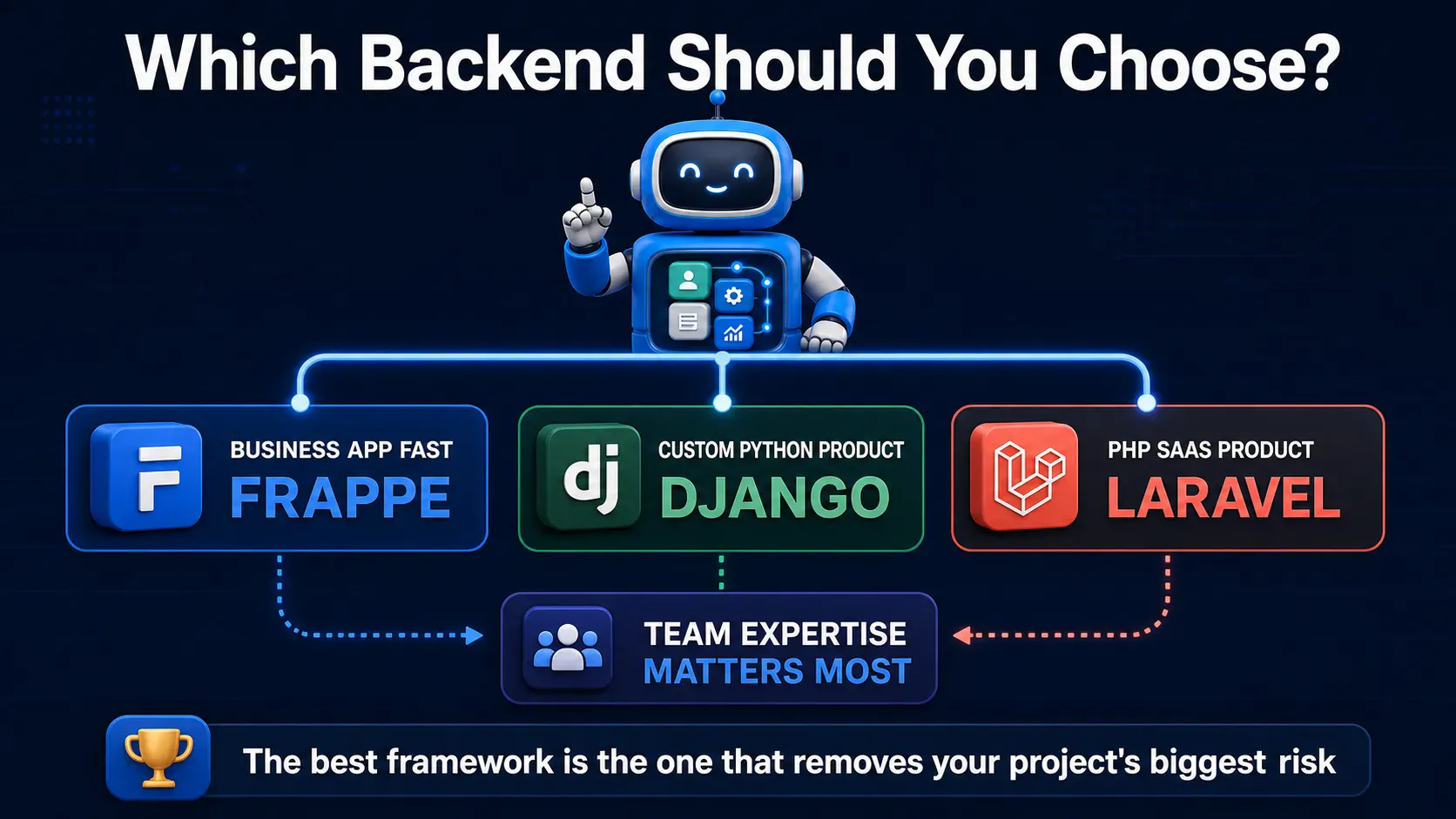
🧩 Choose Frappe if you're building an internal tool, admin-heavy SaaS, or MVP where CRUD, permissions, and an API are 80% of the app, your team is small, and you're comfortable with a smaller hiring pool and Frappe's specific conventions.
🐍 Choose Django if your product involves complex, custom business logic, you value an enormous ecosystem and hiring pool, and you're fine assembling DRF, Celery, and Channels yourself for API, jobs, and real-time.
🎨 Choose Laravel if you're building a customer-facing web app or working with an agency/freelance market where PHP talent is abundant, you want the smoothest managed-hosting experience, and you're comfortable picking Nova or Filament for your admin layer.
There's no universally "best" framework here — only the one that matches your product shape, your team's skills, and your appetite for assembling versus accepting defaults. 🧩 Frappe wins on raw speed for admin-heavy, CRUD-centric products; 🐍 Django wins on ecosystem depth and hiring flexibility for complex logic; 🎨 Laravel wins on developer experience and hosting polish for customer-facing apps. Be honest about your hiring market before you fall for a demo. 🎬 If this comparison helped you think it through, share it with whoever's making the call on your team.
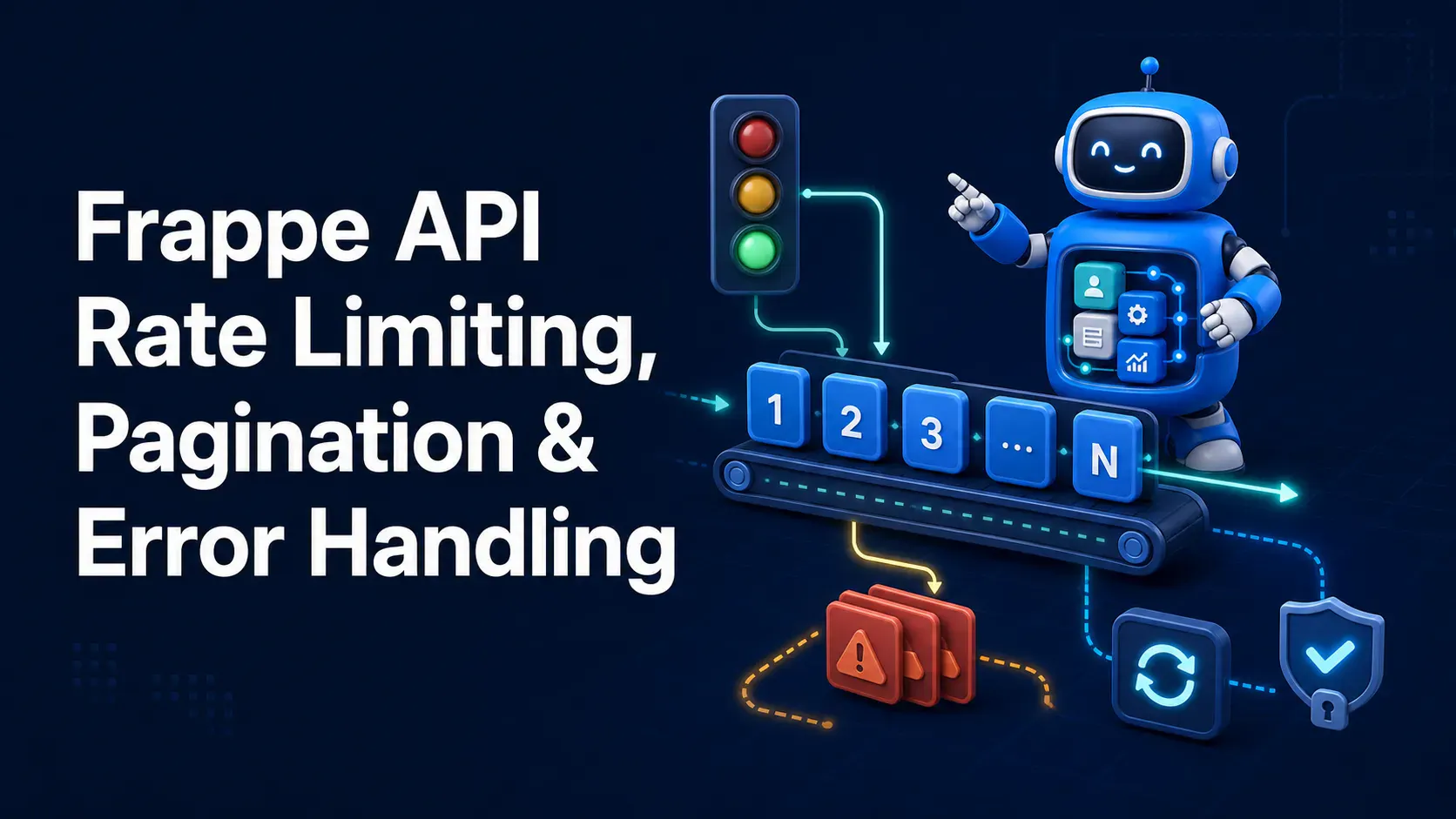
How to paginate large `/api/resource/` calls, configure Frappe's rate limiter, and build consistent error handling on both server and client for production-ready Frappe APIs.